Domesticating Subpoenas Doesn't Have to Be Complicated
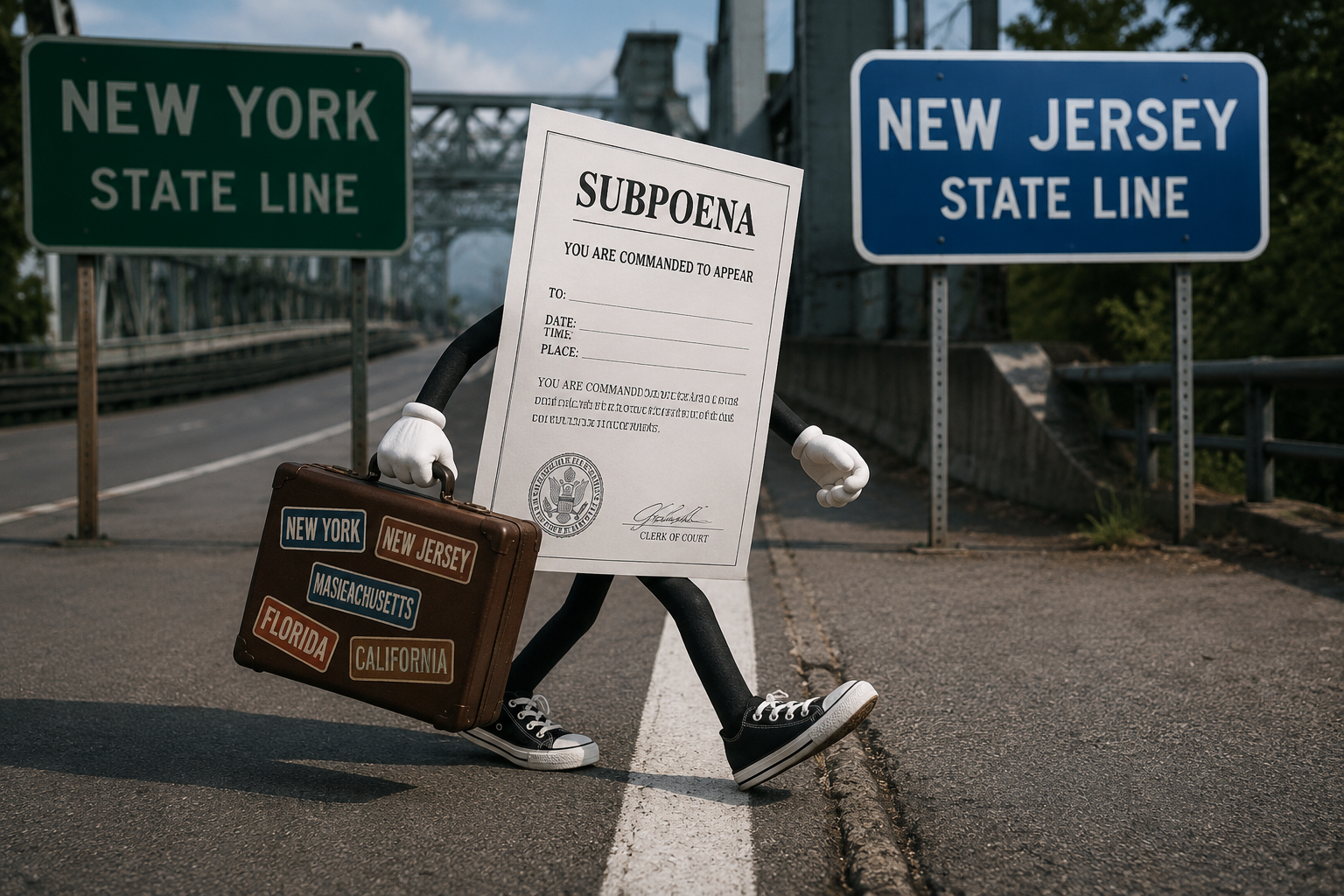
Domesticating Subpoenas: Where every Subpoena Needs a Passport
After years of working with subpoenas, I've come to one conclusion:
Subpoenas are a lot like travelers.
They're perfectly comfortable where they originate. They know where they're going. They have an important purpose. But the moment they try crossing state lines; someone inevitably stops them and asks for paperwork.
That's the world of subpoena domestication.
At ASubpoena, we regularly receive calls from attorneys who have a valid subpoena from Texas, Illinois, Georgia, California, or dozens of other jurisdictions and need records or testimony from someone located in New York, New Jersey, Connecticut, Massachusetts, Florida, or California.
The first question is usually:
"Can you serve this for us?"
The answer is often:
"Not yet—but we'll get you there."
The reality is that a subpoena issued in one state generally doesn't have automatic authority in another. Before it can be served and enforced, it usually needs to be transformed into a subpoena recognized by the state where the discovery is taking place.
Fortunately, we're not living in the legal dark ages.
The Uniform Interstate Depositions and Discovery Act (UIDDA) is the grease that keeps the machinery of interstate discovery moving. It created a framework that allows attorneys to obtain discovery across state lines without the expense and complexity that once accompanied the process.
The UIDDA did something remarkable for lawyers: it made something easier.
Of course, this is still law, so let's not get carried away.
While the UIDDA provides the roadmap, every jurisdiction still has its own procedures, requirements, and local customs. That's where experience becomes valuable.
And nowhere is that more apparent than New York.
New York: One State, Sixty-Two Personalities
Technically, New York has one court system.
Practically speaking, sometimes it feels like sixty-two.
Every county clerk's office has its own procedures, preferences, filing methods, and practical realities. What sails through in one county may require additional documentation in another. Some counties have embraced electronic filing. Others still have procedures that make you appreciate the craftsmanship of paper.
This isn't a criticism—it's simply the reality of practicing in a state as large and diverse as New York.
The challenge for attorneys outside New York is that these differences are rarely obvious until they become a problem.
That's why we spend so much time navigating them.
After handling domestications throughout New York and neighboring states, we've learned that success often comes from understanding not just what the statute says, but how the process works in practice.
The Good News: You Don't Need to Learn Any of This
Seriously.
Unless you're looking for a new hobby, there is no reason to spend your afternoon researching county-specific filing requirements, comparing clerk instructions, or wondering whether a particular foreign subpoena needs modifications before it can be domesticated.
That's our job.
Our process is intentionally simple.
- Send us your foreign subpoena.
- We'll review it, identify any issues before they become delays, prepare the necessary paperwork, coordinate the domestication process, arrange service, and keep you informed along the way.
- In other words, we do the legwork, so you don't have to.
More Than Process Servers
One misconception we occasionally encounter is that domestication is simply a filing task.
In reality, successful subpoena domestication requires understanding how interstate discovery works from start to finish.
A small formatting issue can create delays. Missing information can result in rejection. A misunderstanding about local requirements can add unnecessary time and expense.
Our role isn't simply to serve papers.
Our role is to help clients navigate the entire process; from the moment a foreign subpoena arrives in our inbox until the domesticated subpoena is properly issued and served.
That guidance often saves clients time, money, and frustration.
Interstate Discovery Shouldn't Feel Like Interstate Commerce in 1787
The Founders gave us a constitution so the states could work together.
The UIDDA gave litigators something almost as useful: a practical mechanism for obtaining discovery across state lines.
The system works remarkably well, provided you understand how to navigate it.
That's where we come in.
Whether your subpoena is headed to New York, New Jersey, Connecticut, Massachusetts, Florida, or California, our goal is simple: make the process as smooth as possible.
- No guesswork.
- No unnecessary delays.
- No spending hours trying to decipher local procedures from three different websites and a clerk's voicemail.
- Just send us the subpoena.
We'll review it, guide you through the process, and help it get where it needs to go.
Because every subpoena deserves a passport—and every attorney deserves someone who knows the road.